As AI-powered search experiences continue to evolve, many marketers are asking a new question:
Why does AI recommend one brand for a particular query while recommending an entirely different brand for a seemingly related search?
The answer often lies in search intent.
Unlike traditional search engines that primarily rank web pages, AI systems evaluate intent, context, authority, relevance, and user expectations before generating recommendations. As a result, brand visibility is no longer determined solely by rankings. It is increasingly influenced by how well a brand aligns with specific user intents.
Understanding this relationship is becoming critical for businesses seeking visibility in AI-generated search experiences.
What Is AI Brand Recommendation Consistency?
AI brand recommendation consistency refers to how frequently and reliably a brand appears across different AI-generated responses related to its industry, products, or services.
For example:
A user asks: “Who are the best SEO agencies in Canada?”
An AI system may recommend several agencies.
However, when another user asks, “Which SEO agency is best for local businesses?”
The recommendations may change significantly.
This variation often occurs because AI evaluates intent differently for each query.
Consistency is achieved when a brand appears across multiple intent categories rather than a narrow subset of searches.
Why Search Intent Matters More Than Ever
Traditional SEO largely focused on keywords.
AI search systems focus on user objectives.
A person searching for: “Best HVAC company”
has a different intent than someone searching: “How much does HVAC installation cost?”
Even though both searches relate to the same industry, AI may surface different brands depending on which companies demonstrate expertise for that particular intent.
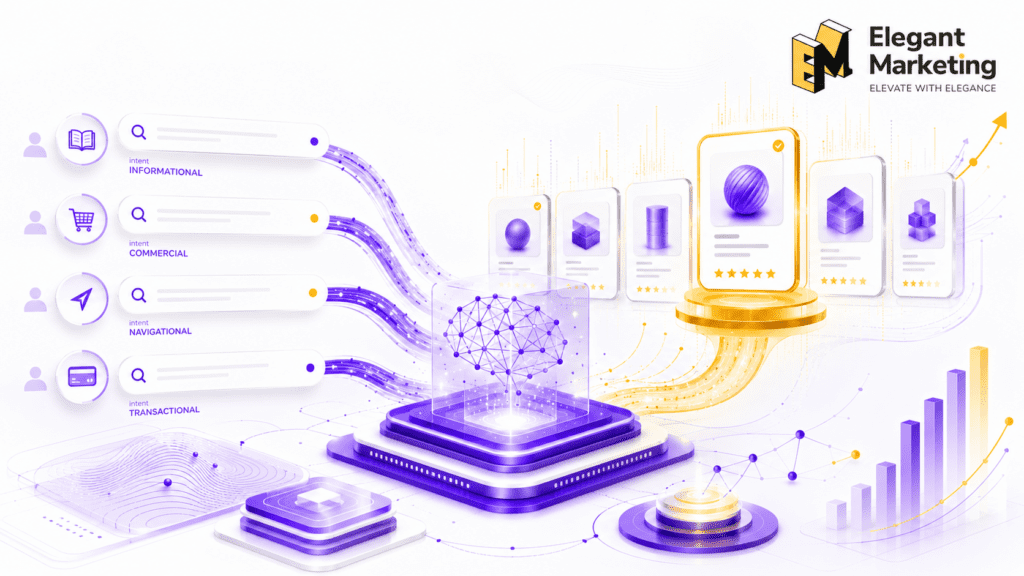
The Four Primary Intent Categories AI Evaluates
Informational Intent
Users are seeking knowledge, education, or guidance.
Examples:
- How does local SEO work?
- What is GEO optimization?
- How long does a roof last?
Brands that consistently publish authoritative educational content tend to perform well for informational intent.
Commercial Investigation Intent
Users are evaluating options before making a decision.
Examples:
- Best digital marketing agency in Vancouver
- Top HVAC companies near me
- Best home renovation contractor
AI often favors brands with:
- Strong reviews
- Industry authority
- Detailed service information
- Demonstrated expertise
Transactional Intent
Users are ready to act.
Examples:
- Hire an SEO consultant
- Emergency plumber Surrey
- Book a roof inspection
Here, AI may prioritize local relevance, service availability, reputation, and conversion-focused content.
Navigational Intent
Users already know the brand they want.
Navigational Intent
Users already know the brand they want to find.
Examples:
- Elegant Marketing reviews
- Elegant Marketing SEO services
- Elegant Marketing contact information
In these situations, AI helps users locate specific information about an established entity.
Why Brands Appear for Some Queries But Not Others
Many businesses mistakenly believe that appearing for one query means they will appear for all related searches.
AI systems don’t work this way.
A brand may:
- Rank highly for informational searches
- Be absent from commercial recommendation queries
Or:
- Dominate transactional searches
- Rarely appear in educational responses
This often occurs because content and authority are concentrated around only one type of intent.
How AI Evaluates Brands Across Intent Types
Generative AI systems typically assess signals such as:
Topical Authority
Does the brand consistently publish content across a subject area?
Entity Recognition
Is the brand recognized and referenced across trusted sources?
Content Depth
Does the content comprehensively answer user questions?
Expertise Signals
Does the brand demonstrate real-world experience and credibility?
User Satisfaction Indicators
Do users appear to find value in the information provided?
The more consistently these signals appear across different intent categories, the more likely a brand is to achieve broader AI visibility.
The Consistency Challenge
Many organizations focus heavily on bottom-funnel content.
Examples include:
- Service pages
- Product pages
- Sales-focused landing pages
While these assets support transactional visibility, they often fail to establish authority for informational and research-driven queries.
As a result, AI systems may recognize the brand for direct purchasing intent but overlook it during earlier stages of the customer journey.
Building Brand Visibility Across Every Intent Stage
Organizations seeking stronger AI visibility should create content for every stage of the customer journey.
Awareness Stage
Answer educational questions.
Examples:
- What is technical SEO?
- How does HVAC maintenance work?
Consideration Stage
Create comparison and evaluation content.
Examples:
- SEO vs PPC
- Heat pump vs furnace
Decision Stage
Develop service-specific and conversion-focused content.
Examples:
- Emergency HVAC repair
- Local SEO services Vancouver
Post-Purchase Stage
Publish support and maintenance resources.
Examples:
- How to maintain a heat pump
- Common SEO reporting metrics
This approach helps create a broader AI visibility footprint.
The Future of GEO: Optimizing for Intent Coverage
As Generative Engine Optimization (GEO) evolves, intent coverage will become increasingly important.
Brands that only optimize for keywords may struggle to maintain visibility.
Brands that align content with multiple user intents are more likely to:
- Appear in AI-generated recommendations
- Increase brand mentions
- Build topical authority
- Improve trust signals
- Maintain visibility across evolving AI systems
Ready to Improve Your Brand’s Visibility in AI Search?
As AI-powered search platforms continue to reshape how users discover businesses, brands need more than traditional SEO to stay visible. Success in generative search requires a strategic approach that combines SEO, GEO, AEO, entity optimization, content strategy, and intent-driven content development.
At Elegant Marketing, a leading digital marketing agency in Canada, we help businesses build authority across every stage of the customer journey, increasing their visibility in search engines, AI-generated recommendations, answer engines, and the next generation of search experiences.
Whether you’re looking to strengthen your organic presence, improve AI search visibility, or develop a comprehensive GEO strategy, our team can help you create a future-ready digital marketing framework.
Our AI Search & SEO Services Include:
- Search Engine Optimization (SEO)
- Generative Engine Optimization (GEO)
- Answer Engine Optimization (AEO)
- Content Strategy & Topic Mapping
- Technical SEO Audits
- Local SEO
- Entity Optimization
- AI Search Visibility Consulting
- Website Content Optimization
- Performance Marketing
Let’s Build an AI-Ready Growth Strategy
If your goal is to increase visibility across Google, ChatGPT, Gemini, Perplexity, and other emerging AI search platforms, Elegant Marketing can help.
Book a Free Strategy Consultation and discover how intent-driven marketing can improve your brand’s discoverability, authority, and long-term growth.